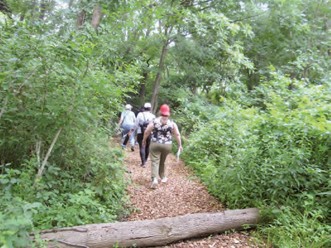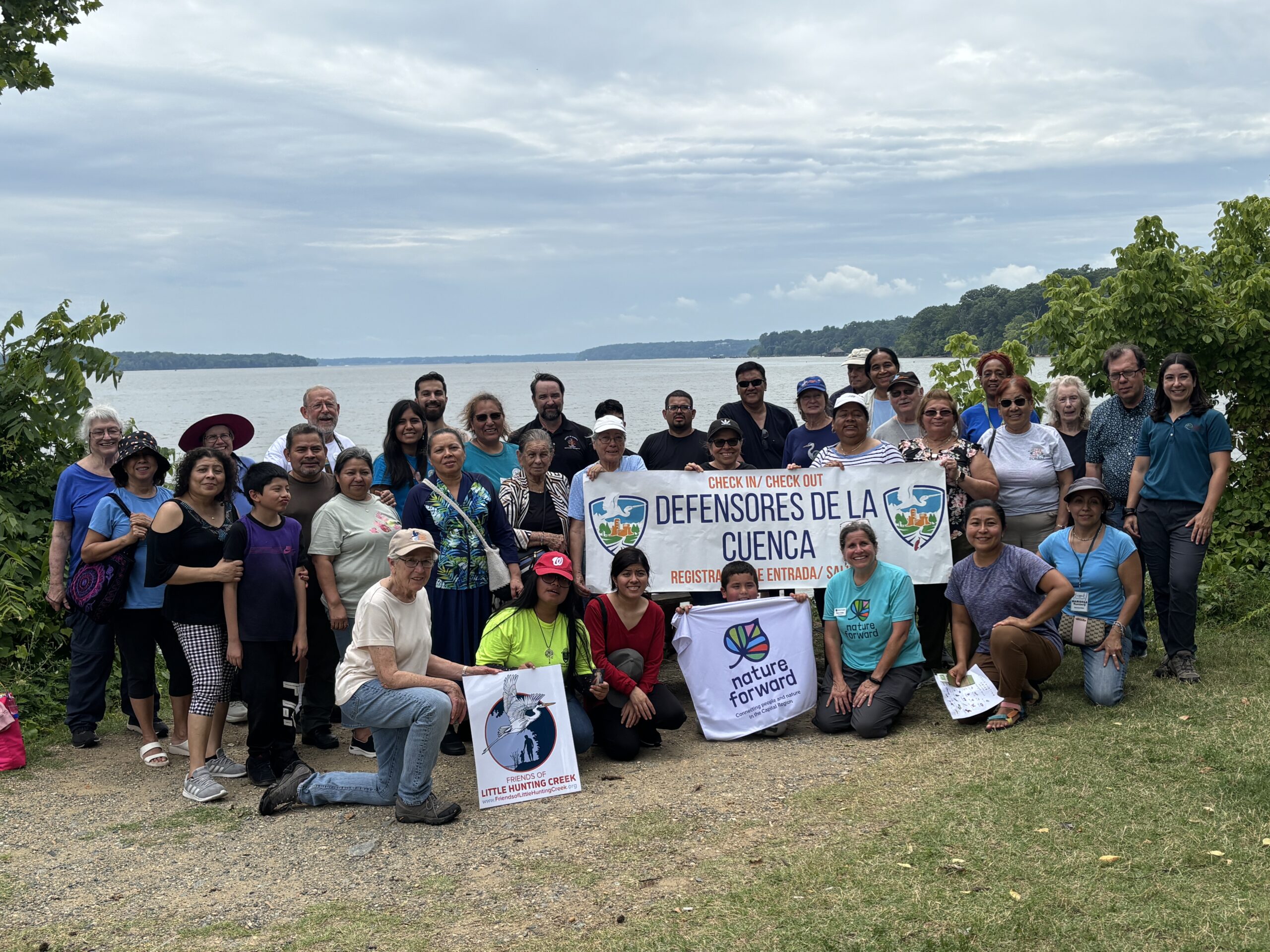
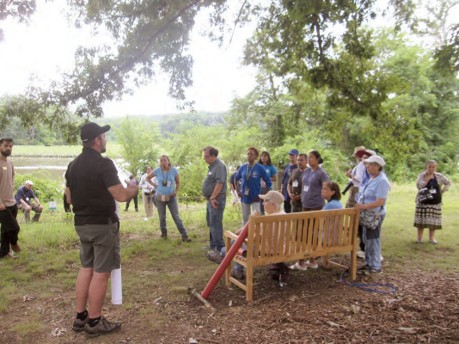
Friends of Little Hunting Creek, Nature Forward and Defensores de la Cuenca organized the tour of the Little Hunting Creek Watershed.
Fairfax County’s streams are sending signals that the way we live and the development patterns sanctioned since the 1940s are degrading our natural resources, especially our streams, 29 people learned on a June 27 bus tour of the Little Hunting Creek Watershed.
Several speakers outlined the problems. Mount Vernon Supervisor Dan Storck kicked it off saying, “We created the situation. We’re now trying to fix it. We must help Mother Nature.”
The Friends of Little Hunting Creek (FoLHC), Nature Forward and Defensores de la Cuenca organized the outing.
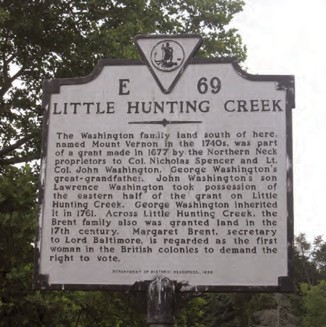
The 11-square-mile Little Hunting Creek Watershed stretches from the Groveton area southeast to the Potomac River and from its headwaters west of U.S. 1 in Huntley Meadows Park. The watershed has some of the oldest development in the county.
Carla Claure, with Defensores de la Cuenca, said, “Through educational, recreational and cultural experiences, we strive to strength-en families’ connection with nature, foster community leadership and create opportunities for more people to become environmental stewards. Our goal is to build more informed, engaged and resilient Latino communities, where every individual has the opportunity to contribute to the conservation of our water, forests, wildlife and the natural spaces we all share.”
FoLHC president Betsy Martin explained that with community input the county developed the Little Hunting Creek Watershed Plan in 2005. “The creek shouldn’t just be an afterthought, a place where trash collects that nobody cares about,” Martin said. “We wanted people to see how beautiful and really wild it is. And only if they care about the creek will they care about preserving it.”
A Raven and Trash
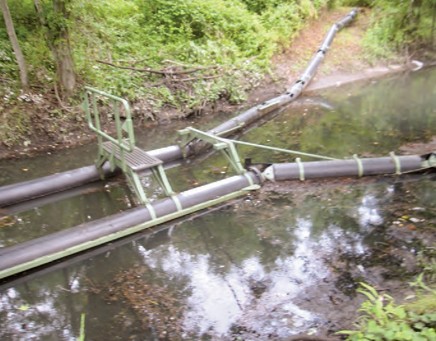
At the first stop, a common raven called above the trash trap behind the Hybla Valley Shopping Center. Justin Pistore, with the County’s Watershed Projects Implementation Branch, explained that since 2020 the trap has snared several thousand bags of trash and shopping carts. Despite the degradation, this part of the creek has killifish, perch and the invasive snakehead fish, said Shannon Curtis, Assistant Director, Stormwater Planning Division.
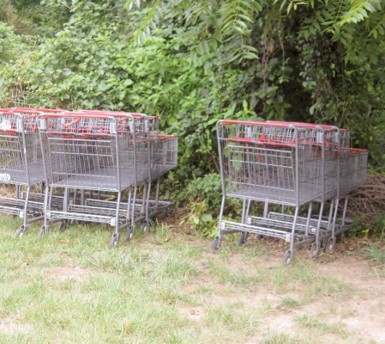
Next up was the Janna Lee Bridge at Tamarind Street, which Martin called “the trashiest place on this creek.” An annual spring cleanup, sponsored by the FoLHC, Senator Scott Surovell and Delegate Paul Krizek pulled out 35 shopping carts in April, she said, adding, “Costco’s carts are big and heavy, hard to get out.” Nine carts stood nearby as she spoke, and one was lodged in the creek.
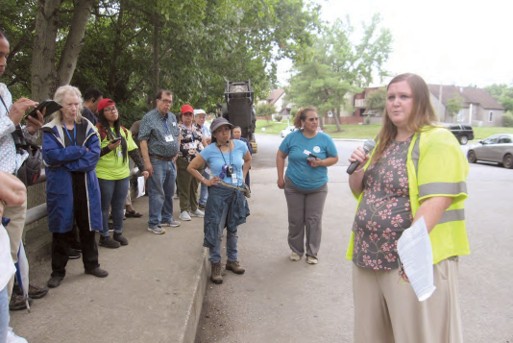
Emily Burton with Operation Stream Shield explained that the county pays unhoused people to pick up trash. Since 2020 they’ve collected 32,000 bags of trash countywide.
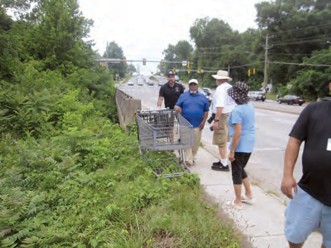
At Napper Road, where the creek flows under U.S. 1, incessant traffic streaked by and within view of another abandoned shopping cart, Ron Chase, President of the Gum Springs Museum and Cultural Center, reflected on his community’s connection to the creek. “There was once lots of water in it, like a rapid,” he said, people caught her-ring and snapping turtles for food and Bethlehem Baptist Church held baptisms in the creek. “Now the stream is almost dead.”
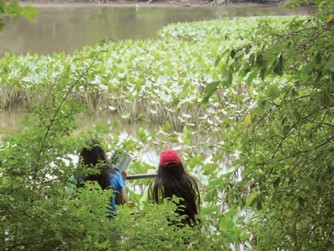
Then the group moved on to Stockton Parkway where the creek is also a tidal wetland, lush with spatterdock and other wetland plants and nesting ospreys calling. “This is a bird-watching hotspot,” Claire Kluskens said. Northern Virginia Conservation Trust easements protect part of the shoreline.
Development Pollutes Streams
Curtis explained that human-made structures like malls, roads and buildings create impervious surfaces which block rain from naturally infiltrating into the ground. “We made things worse for the environment,” he said. He reported in an email later that in 2005 the watershed was 29.5 percent impervious and today, 31 percent. “The watershed was essentially already ‘built out’ in 2005 and only very small areas have increased impervious area since then,” he wrote.
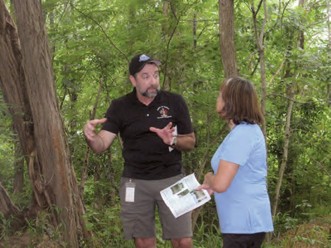
“Now we are rebuilding natural channels so they can heal themselves,” he said on the tour. His office tries to manage both runoff volume and pollution, pollutants like lawn chemicals, car leaks, fertilizers, E. coli bacteria from goose and dog poop and litter.
Improvements?
Fairfax County Environmental Quality Council’s (EQAC) most recent report found, “In 2024, 75 percent of Fairfax County’s streams were considered in ‘fair’ to ‘very poor’ condition; that is, they are impaired and lack biological diversity.” In 2001, 75 percent of the county’s streams were in very poor, poor or fair condition biologically.
Asked why streams have apparently improved little over the last 23 years, Shannon provided a lengthy answer and summarized: “Bottom line: The [Little Hunting Creek] watershed is very stable; it’s already developed and very little new development is occurring, although significant re-development is anticipated. Therefore, we’re not seeing big swings in water quality or stream health.… It will likely take more time and investments to see these improvements.
“Countywide, we are actually seeing some streams improve, some degrade, and some hold steady. … This is due to the increased diversity and abundance of the more pollution-tolerant aquatic organisms. This is a sign of success. We will never have pristine streams in a developed landscape like this, but we do have room for improvements in water quality and stream health, and this is part of our ongoing mission.”
Why the Tour?
“This bus tour demonstrated how people are part of nature and that nature needs people, while uniting different communities in the same watershed to inspire them to take action to protect Little Hunting Creek,” said Grebe.
Shirley Short remarked, “I discovered things I did not know were there.”
Gobbling up pizzas donated by Costco, the group ended the tour in Riverside Park on the shoreline of the Potomac River, named the nation’s “most endangered river” in April.